An acoustic pod can give your team a quieter place for calls or focused work, but it needs to fit the building as well as the floor plan. Before approving one, check its weight, airflow, power, fire-safety arrangements, delivery route and the supplier’s test information.
Key Takeaways
- Ask the supplier for the pod’s dimensions, weight and site requirements before choosing a location.
- Ask building management to confirm that the proposed location and floor are suitable.
- Check airflow, lighting, power, access and door operation with the supplier.
- Keep pods clear of exit routes, and confirm fire-safety arrangements with building management and the relevant fire authority requirements.
- Ask for test data for the exact model and configuration instead of relying on a marketing claim about noise reduction.
The 2-minute version
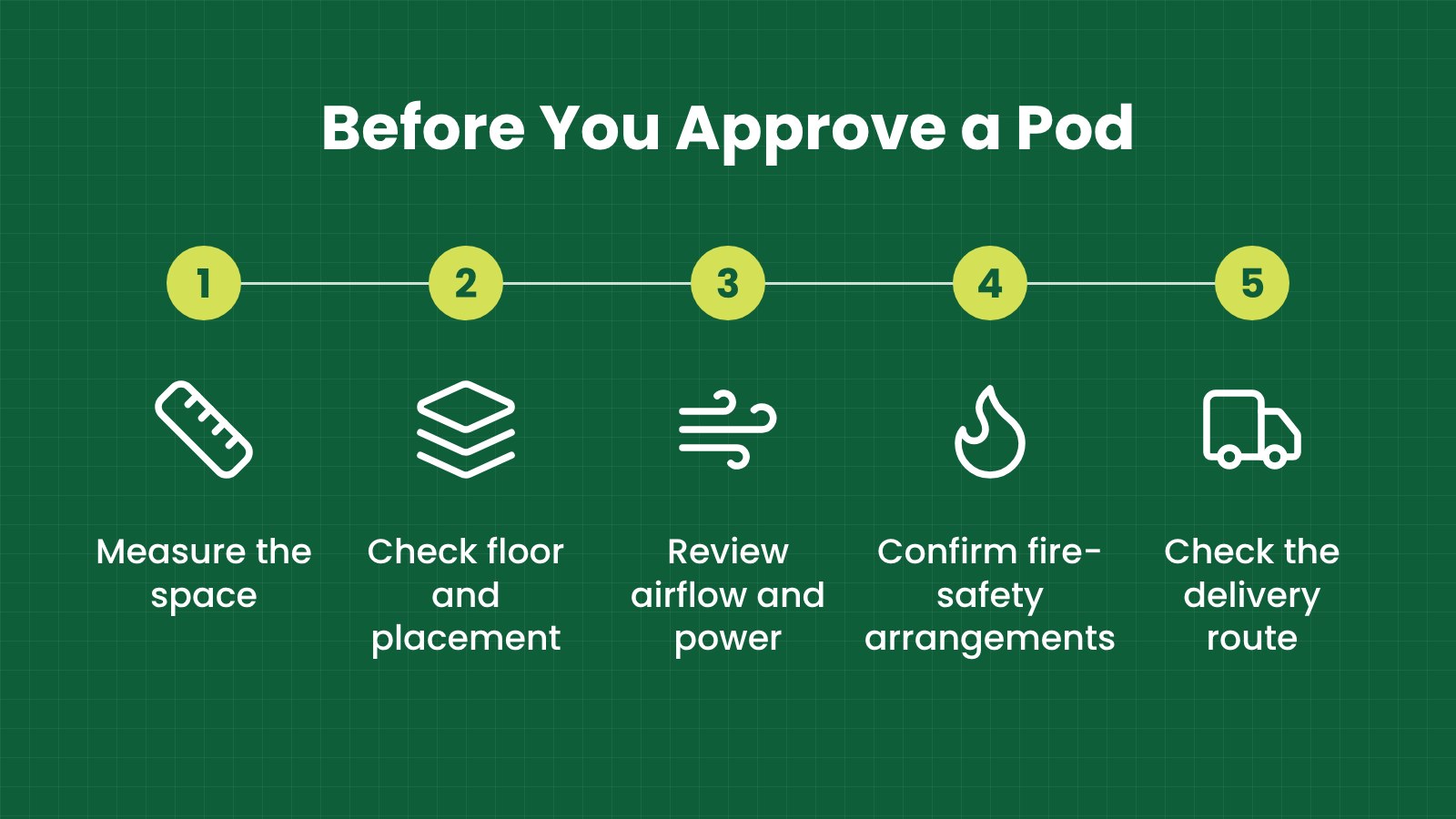
- Measure the space: include the pod, door operation and room to approach it.
- Check the building: ask about floor loading, fire-safety arrangements, power and any building approval process.
- Check the route in: measure lifts, doors, corridors, turns and loading access.
- Ask for product details: request weight, ventilation information, electrical requirements and noise test data.
- Plan installation and future moves: confirm site readiness, installation arrangements and relocation requirements.
What should you check before approving an acoustic pod?
Start with the space and the building. A pod may fit on a drawing but still be difficult to deliver, awkward to use or unsuitable for its proposed position.
Will the pod fit the space and the floor?
Check the pod’s external dimensions, including its door and any parts that open or move. Leave enough room for people to approach and use it comfortably. Ask the supplier for the product weight and any placement information they provide.
Ask building management to confirm whether the proposed floor location is suitable. Share the supplier’s information and the exact proposed position. Avoid assuming that a floor can support a pod just because it can support desks or cabinets nearby.
How does air move through the pod?
Ask the supplier to explain how air enters and leaves the pod, and whether the product has any site requirements for airflow or clear space around it. Check that the proposed location will not block vents or other building equipment.
If the pod will be used for frequent or longer calls, ask how the ventilation is intended to work during use. Review the answer with your facilities team and building management, particularly if the location is enclosed or has limited airflow.
What are the power and lighting requirements?
Find out whether lighting and power points are included, what electrical supply the pod needs and how cables should be routed. Confirm that the planned connection point is practical and can be approved for the site.
Check that cables will not create a trip hazard or block access. Ask who is responsible for arranging any electrical connection, and whether that work needs to be coordinated with the building’s facilities team.
What should you check about fire safety and exit routes?
Ask building management to review the proposed position in relation to the building’s fire-safety arrangements, including sprinkler and smoke detector coverage. Confirm any relevant requirements with building management and the relevant fire authority. Do not assume that existing equipment coverage remains suitable after a pod is placed.
Keep the pod away from exit routes and other areas building management has identified as needing to remain clear. Check how the door works from inside and ask the supplier for the product’s operating information.
For general fire-safety information, see the Fire and Rescue Department of Malaysia safety information. Building-specific questions should be directed to building management and the relevant authority.
Does the pod suit the people who will use it?
Consider how people enter, sit, stand and open the door. Check the approach space, the door swing or sliding path, the interior layout and how the pod will be used by your team.
If different employees or visitors will use it, ask the supplier about the available configurations and review them with your facilities team. A short site check can help reveal access or circulation concerns before an order is placed.
Can the supplier support its noise claims with test data?
Ask for test data for the exact model and configuration you are considering. Check what was tested and under what conditions. A result from a different model or setup may not describe the pod you plan to buy.
Marketing descriptions can help you understand the product’s intended use, but they are not a substitute for test information. Also consider the room around the pod: sound can travel through the wider office, so the result in everyday use may differ from a test environment.
What belongs on a pre-approval checklist?
| Area |
What to check |
Who to ask |
| Space and placement |
Pod dimensions, door operation, approach space and proposed location |
Supplier and facilities team |
| Floor |
Product weight and confirmation that the proposed location is suitable |
Supplier and building management |
| Airflow |
How air moves through the pod and any location or clearance needs |
Supplier and building management |
| Power and lighting |
Electrical requirements, connection point and cable route |
Supplier, facilities team and building management |
| Fire-safety arrangements |
Position relative to sprinklers, smoke detectors and exit routes |
Building management and relevant fire authority |
| Noise information |
Test data for the exact model and configuration |
Supplier |
| Delivery route |
Lift, doors, corridors, turns, loading area and packaged dimensions |
Supplier and building management |
| Installation and relocation |
Site readiness, installation arrangements and future moving requirements |
Supplier and facilities team |
What questions should you ask the supplier?
| Ask the supplier |
Why it helps |
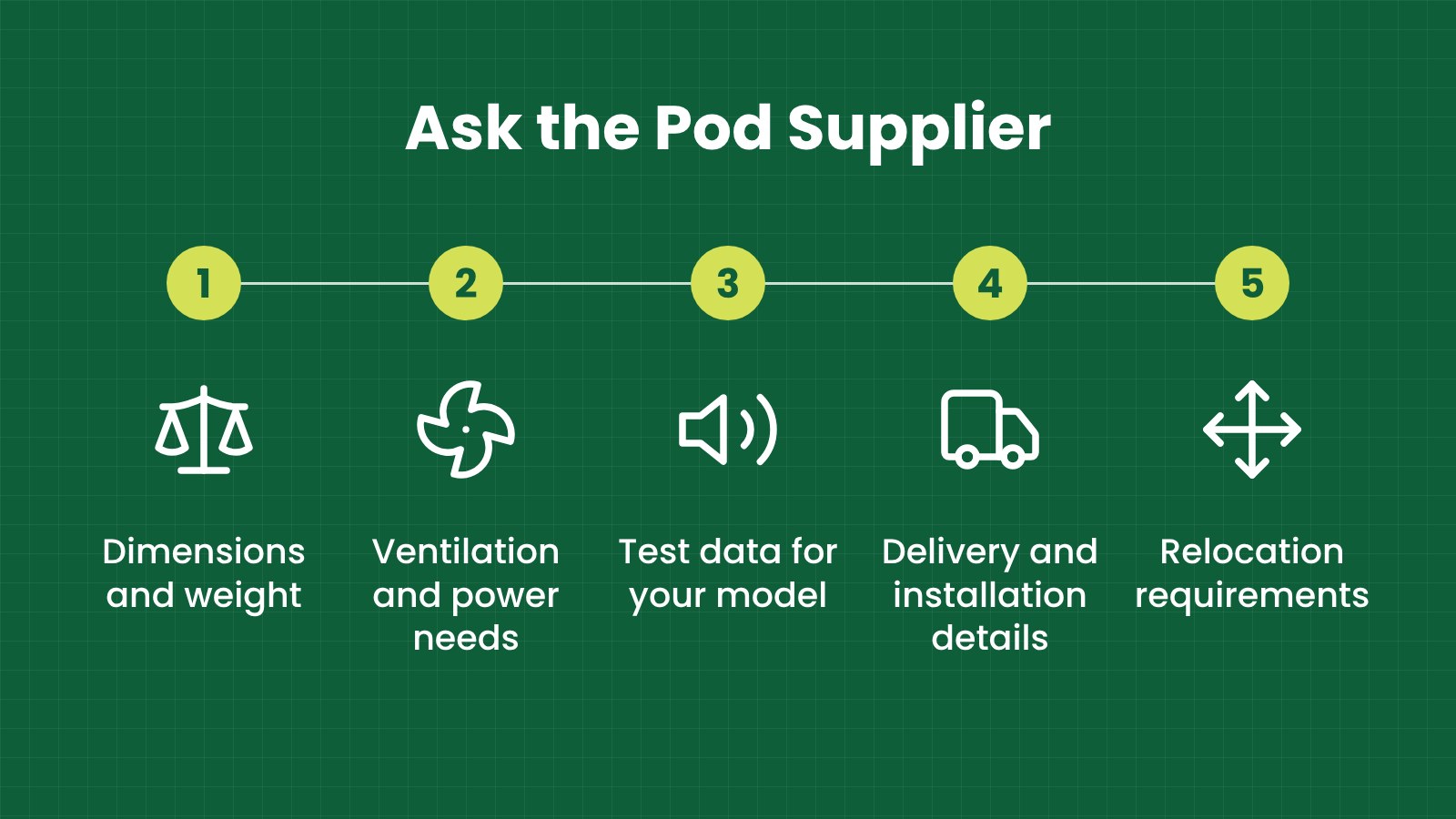
| What are the pod’s dimensions and weight? |
Gives building management information to review the proposed location. |
| How does ventilation work, and does the pod need clear space around it? |
Helps you plan placement and discuss airflow with the facilities team. |
| What power supply and cable routing does it need? |
Helps confirm that a practical connection is available. |
| Can you provide test data for this exact model and configuration? |
Lets your team review the information behind the product’s noise claims. |
| What are the packaged dimensions and delivery requirements? |
Helps check lifts, doors, corridors and loading access before delivery. |
| What does installation involve, and how long does it vary by site? |
Helps plan access and coordinate work; installation time depends on the pod and site conditions. |
| Can the pod be relocated, and what does that involve? |
Helps you understand future moving needs and any site checks to repeat. |
| What site information do you need before confirming the order? |
Helps surface missing measurements or building coordination early. |
How do delivery and installation affect the decision?
Check the route from the loading area to the intended location before confirming delivery. Measure lifts, door openings, corridors and tight turns. Ask whether the pod arrives assembled or in parts, and what packaged dimensions the supplier needs you to check.
Confirm the building’s delivery and installation process with management. Site access, building rules, product configuration and readiness all affect the schedule, so ask the supplier for a plan based on your actual location rather than assuming a standard installation time.
If you may move the pod later, ask whether it can be relocated and what preparation that requires. A new location may need its own review for space, power, building arrangements and delivery access.
Fictional example: a Penang office plans a call pod
A fictional Penang company wants to add a pod beside its open-plan team area. The first proposed spot looks convenient, but the facilities manager checks the pod’s weight, door operation and power needs with the supplier before choosing it.
Building management reviews the proposed position in relation to the floor and fire-safety arrangements. The team then checks the delivery route and asks for test data for the exact model. After these checks, the company can compare suitable locations with clearer information.
What common mistakes should you avoid?
- Ordering before checking the route in: the pod or its components may not pass through a lift, door or corridor.
- Choosing a spot by floor plan alone: the drawing may not show door movement, power access or building equipment.
- Assuming a marketing claim applies to every setup: ask for test data for the model and configuration you are buying.
- Forgetting the building review: coordinate the location, floor, power and fire-safety arrangements with building management.
- Leaving relocation until later: ask in advance what a future move involves and whether the new location needs a fresh review.
How can iGreen help with acoustic pods?
iGreen supplies acoustic phone booths and pods, including WorkaPod, and can help you assess the site before selecting a location. A site check can help your team review space, access and delivery considerations before making a decision.
iGreen can also coordinate delivery and installation in Kuala Lumpur and Penang. Your team should still confirm building-specific placement, fire-safety and access requirements with building management and the relevant authority.
Request a site assessment from iGreen (KL and Penang).
Frequently asked questions
Does an acoustic pod need building approval?
Building processes vary by site. Ask building management what review or approval is needed before ordering, and share the pod’s dimensions, weight, power and placement information.
How do I know whether a pod will fit through the lift?
Ask the supplier for packaged dimensions and delivery details, then measure the full route, including the lift, doors, corridors and turns. Confirm access arrangements with building management.
Should I trust the noise reduction figure in a brochure?
Ask for test data for the exact model and configuration. Review what was tested and under what conditions, and remember that the surrounding room can affect everyday results.
Can an acoustic pod be moved to another office?
It depends on the product and the new site. Ask the supplier how relocation works, then check the new location for space, access, power and building requirements.
Official source