Office furniture’s carbon footprint comes from more than the finished desk or chair. It can include the materials, manufacturing, transport, maintenance and what happens to the furniture when it is no longer needed.
Key Takeaways
- Materials and manufacturing can account for a large part of a furniture product’s footprint, but the amount varies by product and supplier.
- Long-lasting, repairable and reconfigurable furniture can help avoid premature replacement.
- Reuse and refurbishment can extend furniture life when items are still suitable and safe to use.
- Buying only what a space needs can reduce material use, transport and unused stock.
- Ask suppliers for clear product and material information; don’t assume a local product, recycled material or environmental claim automatically means a lower footprint.
The 2-minute version
- Buy for the real need: Check quantities, room plans and how the space will be used.
- Ask what it is made from: Request material and product information that suppliers can support.
- Choose for a longer life: Consider durability, repair options, spare parts and reconfiguration.
- Reuse where practical: Review existing furniture for relocation, repair or refurbishment before replacing it.
- Plan what happens next: Ask about take-back, resale, donation or recycling options when furniture reaches the end of its useful life.
What does furniture carbon footprint mean?
A furniture carbon footprint is an estimate of the greenhouse gas emissions linked to a product over a defined part of its life. Greenhouse gases are gases that contribute to climate change. The estimate depends on which stages are counted and what information is available.
A product assessment may look at material extraction and processing, manufacturing, packaging, transport, use and end of life. The GHG Protocol Product Standard provides a framework for assessing emissions across a product’s life cycle and identifying where reductions may be possible.
Different studies can use different boundaries. One supplier may report materials and manufacturing only, while another includes delivery, use and disposal. Before comparing two figures, check what each one covers, what assumptions were used and whether the products are being compared on the same basis.
Where can furniture emissions come from?
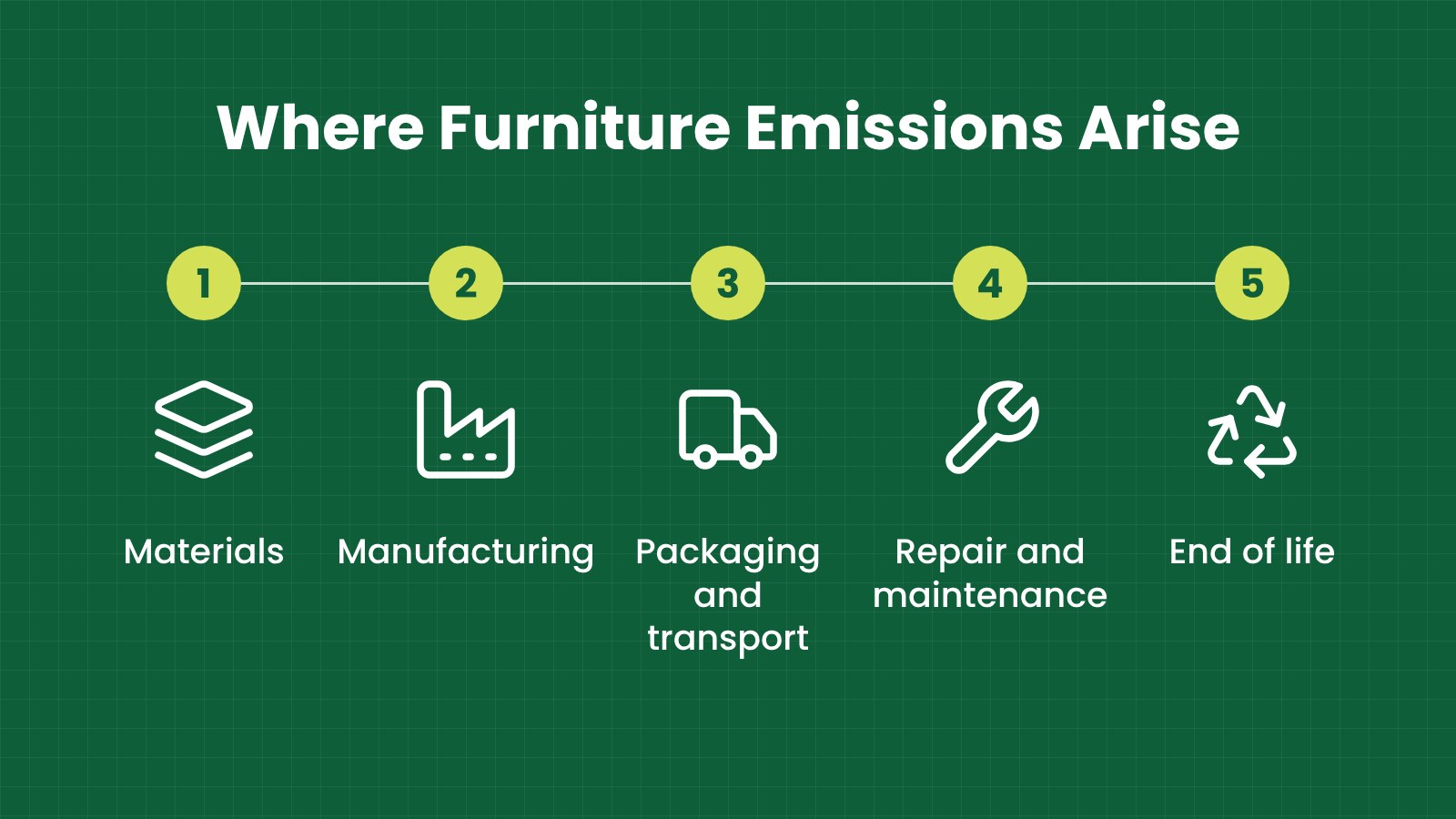
The materials in a chair, desk or storage unit matter. Steel and aluminium need processing before they become furniture components. Particleboard uses wood-based material and binders. Foam, fabric, plastic, coatings and packaging also have their own production processes. Their contribution depends on the product design, material quantities, recycled content and how the materials are made.
Manufacturing uses energy for activities such as cutting, forming, upholstery, assembly and finishing. The energy source and production process can affect the footprint. Two products that look similar may use different materials, factories or manufacturing methods.
Transport moves raw materials, components and finished furniture between suppliers, factories, warehouses and the customer. Distance matters, but so do how goods are packed, how full vehicles are and the modes of transport used. Local supply may shorten one part of the journey, but distance alone does not tell you the whole product footprint.
Ordinary furniture usually does not use energy to operate in the way a powered appliance does. During its use, emissions may still arise from repairs, replacement parts, cleaning products or early replacement. If a desk, chair or cabinet lasts longer and can be maintained, the need to purchase a replacement may be delayed.
At end of life, a product might be repaired, resold, donated, reused, recycled or discarded. What is practical depends on its condition, materials, local services and whether it can be separated into parts. Planning for reuse or take-back can help keep usable furniture and materials in circulation.
| Life stage |
What can contribute |
What a buyer can ask |
| Materials |
Steel, aluminium, particleboard, foam, fabric, plastic and finishes |
What are the main materials, and is there reliable product information? |
| Manufacturing |
Energy and processes used to form, finish and assemble components |
Where is the product made, and what production information can the supplier share? |
| Packaging and transport |
Packaging materials and movement from factory or warehouse to the site |
How is it packed and delivered? Can deliveries be planned efficiently? |
| Use and maintenance |
Repairs, parts, care and early replacement |
Can parts be replaced or the item repaired? |
| End of life |
Reuse, refurbishment, recycling or disposal |
Is take-back, resale or another reuse option available? |
How can buyers reduce furniture’s footprint?
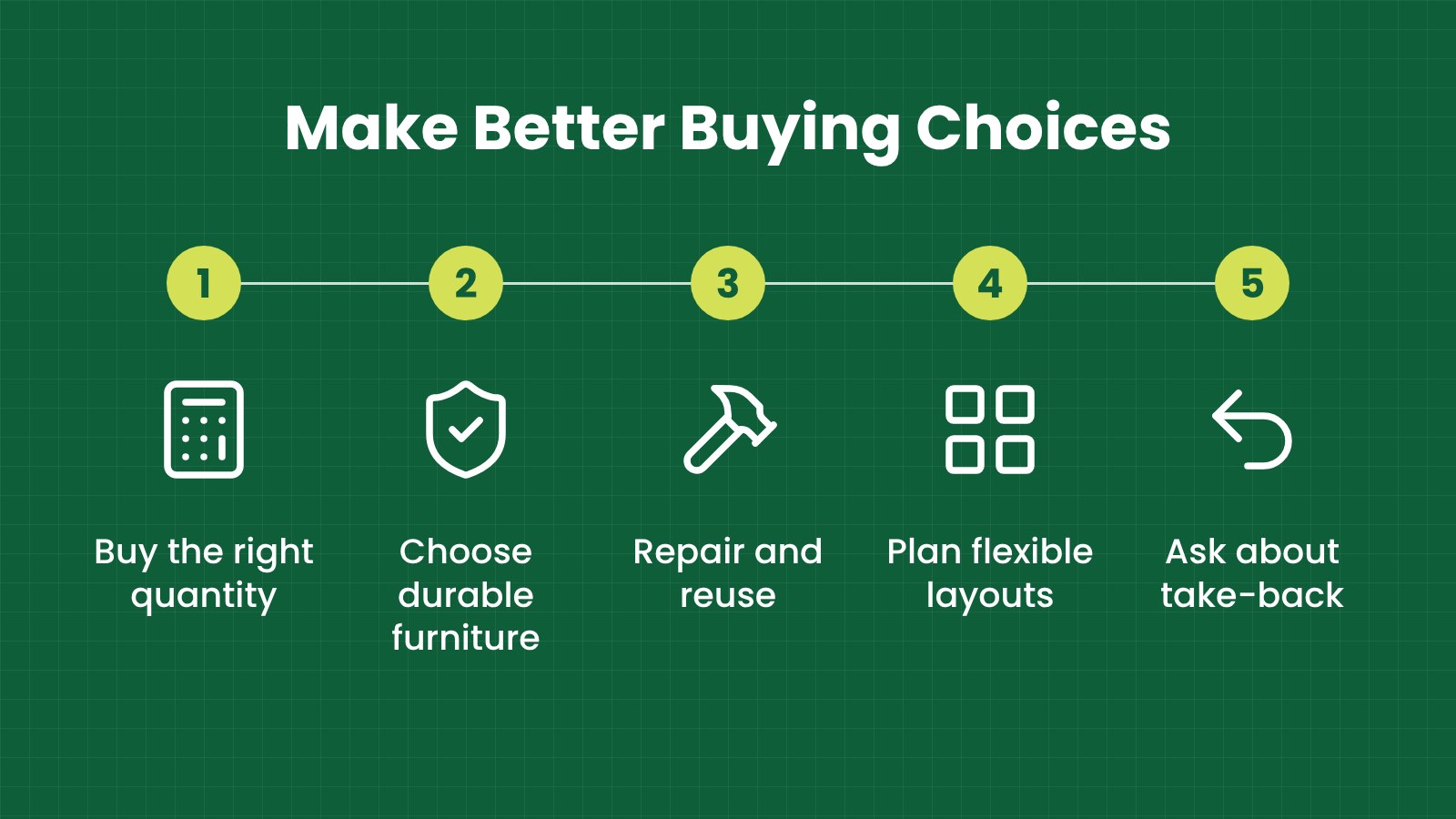
Start by checking what you already own. Some furniture may be moved to another room, repaired or refurbished instead of replaced. A chair with a replaceable component or a workstation that can be reconfigured may continue to serve the business as needs change.
Plan quantities against the space and the way it will be used. Ordering too much can leave furniture unused in storage or lead to disposal when the layout changes. Confirm measurements, user numbers, room function and future needs before finalising an order.
Choose products that suit the job and are built for regular use. Ask about maintenance, available spare parts, repair support and how to care for surfaces. A durable product that can be repaired may help avoid repeat purchases, although the best choice depends on the actual item and its expected use.
Consider modular furniture where teams or rooms may change. Workstations, storage and meeting furniture that can be rearranged may fit a new layout without replacing the entire setup. Check that reconfiguration is practical and does not require parts or labour that are difficult to obtain.
Ask suppliers about packaging and delivery planning. Consolidating orders or coordinating delivery with installation may reduce unnecessary trips. Avoid assuming that nearby supply always has a lower footprint: compare the available product information and transport arrangements where the data is available.
Finally, ask whether the supplier or building operator offers a take-back, refurbishment, resale or recycling route. These options will vary, so agree what is included, how items must be prepared and who arranges collection.
| Buyer action |
Why it can help |
Question to ask |
| Right-size quantities |
Reduces the chance of buying furniture that stays unused |
How many users and work areas need furniture now? |
| Repair and maintain |
May extend the useful life of existing furniture |
Can parts be replaced, and is repair support available? |
| Reuse or refurbish |
Keeps suitable furniture in use and may avoid a new purchase |
Which existing items can be relocated or refreshed? |
| Choose modular layouts |
Can make a future space change easier to manage |
Can components be rearranged or expanded? |
| Reduce packaging and delivery trips |
Can avoid unnecessary packaging and transport activity |
Can deliveries be coordinated and packaging collected? |
| Plan take-back |
May provide a route for reuse or recovery at end of use |
What happens to furniture after collection? |
What product information should you request?
Ask for information that helps you understand the product and make a fair comparison. This might include the main materials, product weight, manufacturing location, packaging details, repair information and any available life-cycle report or Environmental Product Declaration (EPD).
An EPD is a standardised document that reports environmental information about a product based on a life-cycle assessment. It helps communicate information; it does not by itself mean a product is better than another. Review what stages and impacts it covers and whether the products being compared use the same basis.
If a supplier provides a carbon figure, ask what product configuration it represents and which life stages are included. Check the date, method, assumptions and source of the data. A number without context is difficult to compare and may not describe the furniture configuration you are buying.
Companies may ask suppliers for environmental information as part of their own procurement or reporting work. Respond with evidence you have and be clear about what is estimated, incomplete or unavailable. Avoid making claims that go beyond the information supplied.
Why are Malaysian companies asking about this?
Some Malaysian companies are improving sustainability disclosures, answering customer or supplier questionnaires, or contributing information to building projects. The Securities Commission Malaysia describes the National Sustainability Reporting Framework as a framework for sustainability disclosures. Green Building Index tools also consider building performance across areas that include materials and resources. These initiatives do not mean every office furniture purchase has the same reporting requirement; buyers should check the criteria relevant to their company or project.
Fictional Malaysian example: an office refresh in Bayan Lepas
This example is fictional and is for illustration only.
A Penang company is updating two office floors. The first plan replaces every desk and chair, but a walk-through finds that many desks are still in good condition. Some chairs need repair, and a team expects to move to a different layout later in the year.
The facilities team checks which furniture can be reused, asks about repair parts for the chairs and revises the order to cover only the items they still need. It also asks the supplier about delivery coordination, packaging and whether any suitable old furniture can be collected for reuse or refurbishment.
The company records what was reused and what information it received from suppliers. It does not claim a specific emissions reduction because it has not completed a comparable footprint calculation. The practical review helps avoid unnecessary purchases and gives the team better information for future decisions.
What common mistakes should buyers avoid?
- Comparing carbon figures without checking scope: Confirm which life stages and product configurations each figure covers.
- Assuming local always means lower carbon: Manufacturing and materials matter too; ask for comparable information.
- Replacing furniture that could be reused: Review condition, repair options and new space needs first.
- Buying extra “just in case”: Confirm quantities against room plans and actual user needs.
- Treating recycled content as the whole story: Consider durability, repair, transport and end-of-life options as well.
- Assuming an EPD is an endorsement: It reports environmental information; it does not automatically prove a product is lower impact.
- Making claims without supporting information: Keep statements aligned with supplier documents and the scope of the evidence.
How can iGreen help with better furniture planning?
iGreen can help review how your office is used, plan the right furniture quantities and identify items that may be suitable for reuse or refurbishment. We can also recommend durable furniture and reconfigurable layouts that can adapt as your team or space changes.
We can discuss storage, workstation requirements and delivery planning as part of a site assessment. The aim is to help you make practical purchasing and layout decisions that may reduce unnecessary replacement and help reduce risk in day-to-day operations.
We do not claim that iGreen products are low-carbon or certified on the basis of this guide. If you need product-specific environmental information, ask us what documentation is available for the items under consideration.
Request a site assessment from iGreen (KL and Penang).
Frequently asked questions
What part of a desk or chair creates the most emissions?
It varies by product. Materials and manufacturing can be significant contributors, but the answer depends on what the furniture is made from, how it is manufactured and what life stages are counted.
Does buying furniture made in Malaysia always reduce its footprint?
Not necessarily. Local supply may shorten some transport routes, but materials and manufacturing also matter. Compare available product information and delivery arrangements.
Is an Environmental Product Declaration proof that a product is low-carbon?
No. An EPD reports environmental information within a defined scope. Check what it covers and compare products on the same basis.
Can iGreen help us reuse or refurbish existing furniture?
iGreen can help review your space and furniture needs, and discuss practical reuse or refurbishment options as part of planning an office refresh.
Reviewed by
Official sources